Promotional content developed and funded by Novartis Pharmaceuticals UK Ltd
for UK
healthcare professionals only
INGRAIN-MF
Incorporating genetics, risk and
associated burden into MF management
MODULE 4: Optimising management of myelofibrosis and evaluating the use of JAK inhibitors

Fedratinib and momelotinib for disease-related symptoms and splenomegaly in MF
The efficacy and safety profiles of fedratinib and momelotinib in patients with myelofibrosis (MF) were assessed in clinical trials:
JAKARTA trial1
Fedratinib 400 mg* OD (n=96)
vs
placebo (n=96)
Patients with intermediate-2 or high‑risk primary MF, post‑PV, or post‑ET MF
JAKARTA trial dataSIMPLIFY-1 trial2
Momelotinib 200 mg OD (n=214)
vs
ruxolitinib 20 mg BD (n=216)
JAK inhibitor-naive patients with symptomatic intermediate‑1, intermediate‑2 or high‑risk MF
SIMPLIFY-1 trial dataComparisons should not be made between the JAKARTA and SIMPLIFY-1 trials. Data presented here are to show independent key outcomes within each trial.
*The JAKARTA trial also studied the efficacy and safety profile of fedratinib 500 mg (n=97).1 The recommended dose of fedratinib is 400 mg daily.3
BD: twice daily; ET: essential thrombocythaemia; JAK: janus kinase; MF: myelofibrosis; OD: once daily; PV: polycythaemia vera
JAKARTA trial results at Week 241
Proportion of patients achieving ≥35% reduction in spleen volume from baseline
(primary endpoint)
| Fedratinib 400 mg | Placebo |
| 36% n=35/96 95% CI: 27%-46% |
1% n=1/96 95% CI: 0%-3% |
| p<0.001 | |
Proportion of patients achieving ≥50% reduction in total symptom score† from baseline
(key secondary endpoint)
| Fedratinib 400 mg | Placebo |
| 36% n=33/91 95% CI: 26%-46% |
7% n=6/85 95% CI: 2%-13% |
| p<0.001 | |
†Assessed using the modified Myelofibrosis Symptom Assessment Form
The fedratinib group showed clinically and statistically significant differences vs placebo in the achievement of ≥35% reduction in spleen volume and ≥50% reduction in total symptom scores.1
Safety profile and tolerability of fedratinib
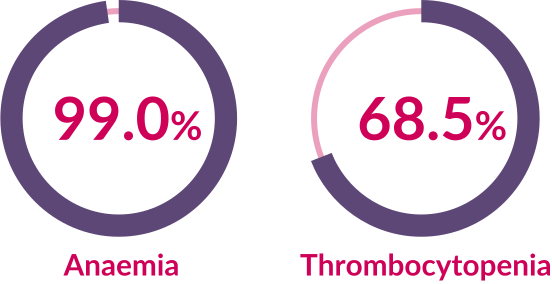
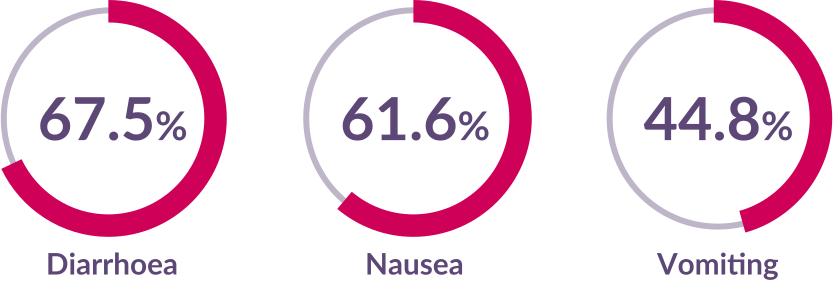
Among patients with MF treated with a 400 mg dose of fedratinib in several clinical studies (n=203), the most frequently reported adverse events were:3
Haematological AEs
Non-haematological AEs
Discontinuation due to adverse events, regardless of causality, was observed in 24% of patients receiving 400 mg of fedbratinib.3
SIMPLIFY-1 trial results at Week 242
Proportion of patients achieving ≥35% reduction in spleen volume from baseline
(primary endpoint)
| Momelotinib | Ruxolitinib |
| 26.5% (n=57/215) |
29.0% (n=63/217) |
| Non-inferiority proportion difference:
0.09 95% CI: 0.02-0.16 p=0.11 for non-inferiority |
|
Proportion of patients achieving ≥50% reduction in total symptom score from baseline
(key secondary endpoint)
| Momelotinib | Ruxolitinib |
| 28.4% (n=60/211) |
42.2% (n=89/211) |
| Non-inferiority proportion difference: 0.09
95% CI: -0.08 to 0.08 p=0.98; non-inferiority was not met |
|
Momelotinib was non-inferior to ruxolitinib in spleen response; momelotinib was not non-inferior to ruxolitinib at symptom control.
Safety and tolerability profiles of momelotinib and ruxolutinib2
The most common treatment-emergent AEs (TEAEs) occurring in ≥10% of either treatment group in SIMPLIFY-1 (n=214 for momelotinib group; n=216 for ruxolitinib):
Haematological TEAEs
| Momelotinib | Ruxolitinib | |
| Thrombocytopenia | 18.7% | 29.2% |
| Anaemia | 13.6% | 38.0% |
Haematological TEAEs
| Momelotinib | Ruxolitinib | |
| Diarrhoea | 17.8% | 19.9% |
| Nausea | 15.9% | 3.7% |
| Abdominal pain | 10.3% | 11.1% |
Other TEAEs
| Momelotinib | Ruxolitinib | |
| Headache | 17.3% | 19.9% |
| Dizziness | 15.9% | 11.6% |
| Fatigue | 14.5% | 12.0% |
Treatment discontinuation was reported for 18.6% of patients in the momelotinib group and 7.4% in the ruxolitinib group.2
The safety profile of momelotinib in patients with MF showed fewer events of anaemia and thrombocytopenia compared with ruxolitinib and a higher incidence of nausea.2
Adverse events should be reported. Reporting forms and information can be found at
www.mhra.gov.uk/yellowcard.
Adverse events should also be reported to Novartis online through the pharmacovigilance intake (PVI) tool at
www.novartis.com/report
or alternatively email medinfo.uk@novartis.com or call 01276 698370
References
- Pardanani A, Harrison C et al. Safety and efficacy of fedratinib in patients with primary or secondary myelofibrosis: a randomized clinical trial. JAMA Oncol 2015;1:643-651
- Mesa R A, Kiladjian J J et al. SIMPLIFY-1: a phase III randomized trial of momelotinib versus ruxolitinib in janus kinase inhibitor-naive patients with myelofibrosis. J Clin Oncol 2017;35:3844-3850
- Inrebic®▼ (fedratinib) Summary of Product Characteristics. Available at: medicines.org.uk. Accessed August 2025