Promotional content developed and funded by Novartis Pharmaceuticals UK Ltd
for UK
healthcare professionals only
INGRAIN-MF
Incorporating genetics, risk and
associated burden into MF management
MODULE 4: Optimising management of myelofibrosis and evaluating the use of JAK inhibitors

The treatment landscape in MF
Goals of care in myelofibrosis (MF)1
Primary treatment goals
- Cure the disease
- Prolong survival
Secondary treatment goals
- Reduce disease burden through symptom management
- Improve quality of life
MF treatment landscape2-4
The following treatment strategy is based on the BSH and ELN guidelines and a 2021 annual clinical update on primary MF.2-4
Overall considerations for MF management depend on the prognostic group.3
Click on a prognostic risk category to reveal the treatment algorithm.
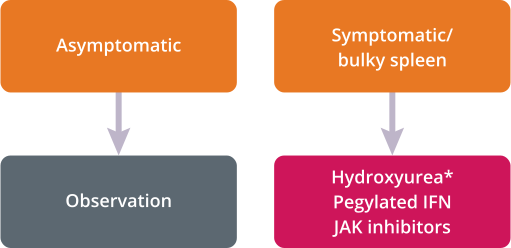
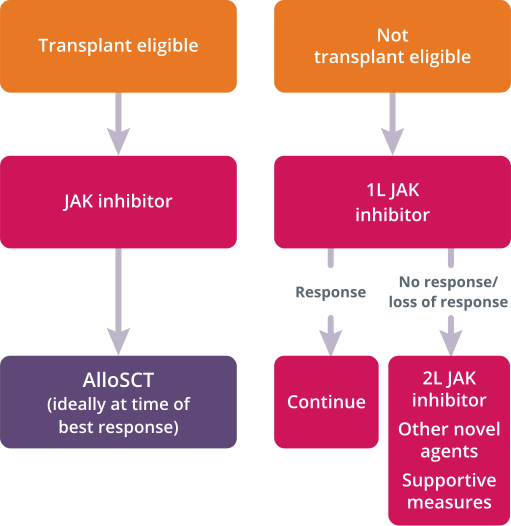
1L: first line; 2L: second line; AlloSCT: allogeneic stem cell transplant; BSH: British Society for Haematology; ELN: European LeukemiaNet; IFN: interferon; JAK: Janus kinase
Symptom-directed conventional therapies
There is often discordance between spleen size, symptom burden and risk stratification group; each patient will require an individual assessment to determine the optimum treatment approach.3
Symptom-directed therapies are indicated for low- and intermediate‑risk patients, and those in higher risk categories that are not eligible for alloSCT.4 Anaemia and thrombocytopenia should be treated at any stage of treatment in all risk categories.3
Click the boxes to reveal treatment choices for each disease component.
Note - this is not an exhaustive list of treatment options. Please refer to the relevant Summary of Product Characteristics before prescribing a medicine.
Low/ intermediate risk with symptoms/ bulky spleen
ESA: erythropoiesis‑stimulating agent
AlloSCT is the only treatment option with curative potential.3,5 The risks associated with it are high, therefore it should only be considered for patients with poor prognosis:2,3
- disease-free survival: 33% in matched related transplants; 27% in unrelated transplants4
- treatment-related mortality: 35% in matched related transplants; 50% in unrelated transplants4
Eligibility and considerations for alloSCT
Consider alloSCT in patients who:2,3,5
- have high (or intermediate-2) risk disease†
- are ≤70 years old
- are fit enough to undergo the procedure
- have manageable comorbidities
†According to IPSS, DIPSS or DIPSS+. Some intermediate-1 risk patients may be considered if <65 years old and present with transfusion‑dependent anaemia, circulating blasts >2% or adverse molecular/ cytogenetic factors.2,3
High-risk factors include:5
- spleen extending >22 cm
- red blood cell transfusion of >20 units
- being transplanted from an HLA non‑identical donor
- low performance status (ECOG status >2)
- high comorbidity index (HCT-CI score >3)
- presence of portal hypertension
DIPSS: Dynamic International Prognostic Scoring System; ECOG: Eastern Cooperative Oncology Group; HCT‑CI: haematopoietic cell transplantation‑specific comorbidity index; HLA: human leukocyte antigen; IPSS: International Prognostic Scoring System
Apart from alloSCT, treatment for MF is considered to be palliative, and guided by disease‑related symptoms typically associated with splenomegaly and anaemia. Low‑risk patients who are asymptomatic can be observed with no intervention.2,4,6 Regular symptom monitoring may aid decision‑making about which, if any, treatment should be initiated.7
Pharmacotherapy for symptom control and splenomegaly
Hydroxyurea is moderately effective and used to be the traditionally preferred agent for MF-associated splenomegaly (in the absence of cytopenia):2,4
- Reduces spleen size by half in approximately 40% of patients4
- Average spleen response duration: 1 year4
- Side effects include: myelosuppression, mucocutaneous ulcers4
Since newer treatments have become available, hydroxyurea is now first-line therapy in patients with intermediate-1 risk if ruxolitinib is not indicated and in low‑risk patients in need of therapy for MF‑associated splenomegaly.2 It can be useful where the primary indication for treatment is control of proliferative blood counts.3
Not all forms of interferon therapy are licensed for use in MF. Please refer to the SmPC before prescribing.
Interferon-alpha is of limited value in treating MF‑associated splenomegaly.4
Pegylated interferons may be considered in patients who are at low or intermediate‑1 risk with proliferative counts or in patients with pre‑fibrotic MF.3
Dysregulation and constitutional activation of the JAK-STAT pathway are associated with the development of the MF disease state.8,9 JAK inhibitors have the potential to attenuate this overactivated signalling.8
Ruxolitinib is a JAK1/2 inhibitor, the first JAK inhibitor licensed in the UK for treatment of disease-related splenomegaly or symptoms in myelofibrosis since 2012.10 It is a treatment for symptomatic splenomegaly and constitutional symptoms.4,10
Momelotinib is a JAK1/2 inhibitor and activin A receptor type 1 (ACVR1) inhibitor licensed in 2024.3,11 It is an effective treatment of the triad of MF-associated constitutional symptoms, splenomegaly and anaemia.3 BSH particularly recommends its consideration for MF with anaemia, irrespective of being used in first, second or higher lines of therapy.3
Fedratinib is a JAK2-selective inhibitor licensed in 2021 and also indicated for the treatment of MF-related splenomegaly and symptoms.12It is recommended by NICE as a second-line JAK inhibitor after ruxolitinib and where momelotinib is unsuitable, and the company provides fedratinib according to the commercial arrangement.13
Despite effectiveness with regards to splenomegaly and symptom control, JAK inhibitors appear to provide limited benefit for reducing bone marrow fibrosis or inducing a partial or complete molecular response.14,15
NICE recommendationsJAK-STAT: Janus kinase-signal transducer and activator of transcription
JAK: Janus kinase
Real-world data: management strategies employed in the UK21

A retrospective study in 15 UK secondary care centres of 200 patients with primary (63%) or secondary (37%) MF investigated the management strategies currently applied in clinical practice.

- 'Watch and wait' was the first management strategy for 54% of patients
- Median time from diagnosis to active treatment for these patients was 322 days (IQR: 130-610 days)
IQR: interquartile range
Most common management strategies according to IPSS risk status:
| n (%) | Low (n=26) |
Intermediate-1 (n=70) |
Intermediate-2 (n=65) |
High (n=39) |
| Watch and wait/ supportive care‡ | 15 (58%) | 43 (61%) | 31 (48%) | 18 (46%) |
| Ruxolitinib | 2 (8%) | 8 (11%) | 15 (23%) | 10 (26%) |
| Hydroxyurea | 8 (31%) | 14 (20%) | 13 (20%) | 10 (26%) |
‡Includes treatment for anaemia.
Adapted from Mead A J et al, 201921
Continue to next section: Fedratinib and momelotinib for disease-related symptoms and splenomegaly in MF
Adverse events should be reported. Reporting forms and information can be found at
www.mhra.gov.uk/yellowcard.
Adverse events should also be reported to Novartis online through the pharmacovigilance intake (PVI) tool at
www.novartis.com/report
or alternatively email medinfo.uk@novartis.com or call 01276 698370
References
- Barbui T, Barosi G et al. Philadelphia-negative classical myeloproliferative neoplasms: critical concepts and management recommendations from European LeukemiaNet. J Clin Oncol 2011;29:761-770
- Barbui T, Tefferi A et al. Philadelphia chromosome-negative classical myeloproliferative neoplasms: revised management recommendations from European LeukemiaNet. Leukemia 2018;32:1057-1069
- McLornan D P, Psaila B et al. The management of myelofibrosis: A British Society for Haematology Guideline. Br J Haematol 2024;204:136-150
- Tefferi A. Primary myelofibrosis: 2021 update on diagnosis, risk-stratification and management. Am J Hematol 2021;96:145-162
- Kroger N M, Deeg J H et al. Indication and management of allogeneic stem cell transplantation in primary myelofibrosis: a consensus process by an EBMT/ELN international working group. Leukemia 2015;29:2126-2133
- Vannucchi A M, Barbui T et al. Philadelphia chromosome-negative chronic myeloproliferative neoplasms: ESMO Clinical Practice Guidelines for diagnosis, treatment and follow-up. Ann Oncol 2015;26 Suppl 5:v85-99
- Emanuel R M, Dueck A C et al. Myeloproliferative neoplasm (MPN) symptom assessment form total symptom score: prospective international assessment of an abbreviated symptom burden scoring system among patients with MPNs. J Clin Oncol 2012;30:4098-4103
- Komrokji R, Verstovsek S. Assessing efficacy in myelofibrosis treatment: a focus on JAK inhibition. Expert Rev Hematol 2012;5:631-641
- Vainchenker W, Kralovics R. Genetic basis and molecular pathophysiology of classical myeloproliferative neoplasms. Blood 2017;129:667-679
- Ruxolitinib Summary of Product Characteristics. Available at: medicines.org.uk
- Omjjara®▼ (momelotinib) Summary of Product Characteristics. Available at: medicines.org.uk
- Inrebic®▼ (fedratinib) Summary of Product Characteristics. Available at: medicines.org.uk
- National Institute of Health and Care Excellence (NICE). Technology appraisal guidance 1018. Fedratinib for treating disease-related splenomegaly or symptoms in myelofibrosis, November 2024. Available at: nice.org.uk. Accessed August 2025
- Bose P, Verstovsek S. JAK inhibition for the treatment of myelofibrosis: limitations and future perspectives. Hemasphere 2020;4:e424
- Pardanani A, Tefferi A. Definition and management of ruxolitinib treatment failure in myelofibrosis. Blood Cancer J 2014;4:e268
- National Institute of Health and Care Excellence (NICE). Technology appraisal guidance 386. Ruxolitinib for treating disease-related splenomegaly or symptoms in adults with myelofibrosis, March 2016 (last reviewed July 2019). Available at: nice.org.uk. Accessed August 2025
- National Institute of Health and Care Excellence (NICE). Technology appraisal guidance 957. Momelotinib for treating myelofibrosis-related splenomegaly or symptoms, March 2024. Available at: nice.org.uk. Accessed August 2025
- Scottish Medicines Consortium (SMC). SMC No 867/13. Ruxolitinib (as phosphate), 5 mg, 10 mg, & 20 mg tablets (JAKAVI®), March 2015. Available at: scottishmedicines.org.uk. Accessed August 2025
- Scottish Medicines Consortium (SMC). SMC2636. Momelotinib film coated tablet (Omjjara®), June 2024. Available at: scottishmedicines.org.uk. Accessed August 2025
- Scottish Medicines Consortium (SMC). SMC2462. Fedratinib 100mg hard capsules (Inrebic®), April 2022. Available at: scottishmedicines.org.uk. Accessed August 2025
- Mead A J, Butt N M et al. A retrospective real-world study of the current treatment pathways for myelofibrosis in the United Kingdom: the REALISM UK study. Ther Adv Hematol 2022;13:20406207221084487
© NICE 2024 Fedratinib for treating disease-related splenomegaly or symptoms in myelofibrosis. Available from www.nice.org.uk/guidance/ta1018. All rights reserved. Subject to Notice of rights.
© NICE 2016 Ruxolitinib for treating disease-related splenomegaly or symptoms in adults with myelofibrosis. Available from www.nice.org.uk/guidance/ta386. All rights reserved. Subject to Notice of rights.
© NICE 2024 Momelotinib for treating myelofibrosis-related splenomegaly or symptoms. Available from www.nice.org.uk/guidance/ta957. All rights reserved. Subject to Notice of rights.
NICE guidance is prepared for the National Health Service in England. All NICE guidance is subject to regular review and may be updated or withdrawn. NICE accepts no responsibility for the use of its content in this product/ publication.