Promotional content developed and funded by Novartis Pharmaceuticals UK Ltd
for UK
healthcare professionals only
INGRAIN-MF
Incorporating genetics, risk and
associated burden into MF management
MODULE 3: A personalised approach to predicting prognosis in myelofibrosis

The ‘mutation-enhanced’ IPSS was published in 2018, and combines variables associated with common mutations in myelofibrosis (MF) with the risk factors scored in IPSS.
In a study of 805 patients with primary MF, aged ≤70 years old, the effect of 22 variables on overall survival was investigated. This analysis led to the development of two scoring methods, with or without cytogenetic information: MIPSS70+ and MIPSS70.
Weighted scores per variable were determined based on the relative hazard ratio value for that variable compared with the median hazard ratio value of all variables. Genetic factors found to be prognostic in this model include one driver mutation (absence of a type-1 like mutation to the CALR gene) and several non-driver mutations (any mutation to ASXL1, EZH2, SRSF2 or IDH1/2 - defined as high molecular risk, HMR).
1 point:
- Hb <10 g/dL
- circulating blasts ≥2%
- fibrosis grade
- constitutional symptoms
- absence of CALR type 1-like mutation
- HMR mutation
2 points:
- white blood cell count >25 x 109/L
- platelet count <100 x 109/L
- ≥2 HMR mutations
| Risk group | MIPSS70 score | Median survival (years) |
| Low | 0 | |
| Intermediate | 2-4 | |
| High | ≥5 |
Comparison of IPSS and MIPSS70 scores4
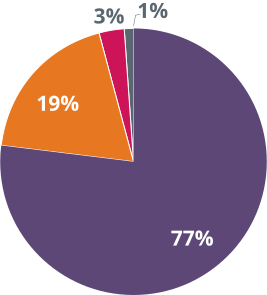
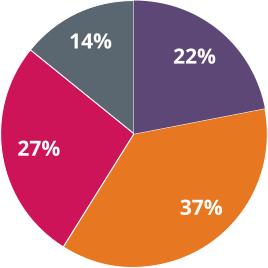
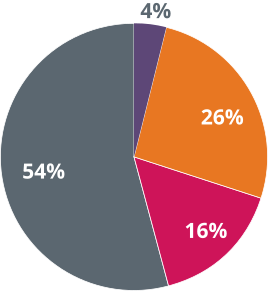
For many patients for whom genetic information is available, using MIPSS70 gives a different risk category than the IPSS score. In the original study, 77% of IPSS low‑risk patients were classified as low risk by MIPSS70, and 54% of IPSS high‑risk patients were high risk by MIPSS70.
IPSS risk categories of patients categorised as low, intermediate or high risk by MIPSS704
MIPSS70 low
(n=237)
MIPSS70 intermediate
(n=198)
MIPSS70 high
(n=54)

MIPSS70+4
The MIPSS70+ variation to this scoring system does not include fibrosis grade, leukocytosis or thrombocytopenia, but does include unfavourable karyotype. This has since been refined in MIPSS70+ v2.0.
MIPSS70+ v2.0 was published as another iteration of the mutation-enhanced scoring system, with
the following alterations:
- very high risk karyotype, as distinguished from unfavourable karyotype (included in MIPSS70+)
- U2AF1 Q157 mutation also classified as high molecular risk (HMR)
- anaemia differentially classified as moderate or severe
1 point:
- Hb 8.0-9.9 g/dL (women) or 9.0-10.9 g/dL (men)
- circulating blasts ≥2%
2 points:
- Hb <8 g/dL (women) or <9 g/dL (men)
- constitutional symptoms
- absence of CALR type-1 like mutation
- HMR mutation*
3 point:
- ≥2 HMR mutations*
- unfavourable karyotype†
4 points:
- very high risk karyotype†
*Defined as a ASXL1, EZH2, SRSF2, IDH1/2 or U2AF1 Q157
mutation.4
†Very high risk: single/ multiple abnormalities of −7, i(17q), inv(3)/3q21, 12p−/12p11.2,
11q−/11q23 or other autosomal trisomies not including +8/+9 (eg +21, +19); favourable: normal
karyotype or sole abnormalities of 13q−, +9, 20q−, chromosome 1 translocation/ duplication or sex
chromosome abnormality including -Y; unfavourable: all other abnormalities.7
| Risk group | MIPSS70+ v2.0 score | Median survival (years) |
| Very low | 0 | |
| Low | 1-2 | |
| Intermediate | 3-4 | |
| High | 5-8 | |
| Very high | ≥9 |
The Genetically-inspired International Prognostic Scoring System, GIPSS, is a lower complexity tool for risk stratification of patients with primary MF,8 which utilises only cytogenetic and genetic information, originally tested in a study of 641 patients.6
1 point:
- unfavourable karyotype
- absence of CALR type-1 like mutation
- HMR mutation‡
2 points:
- very high risk karyotype
‡Defined as an ASXL1, SRSF2 or U2AF1 Q157 mutation.
| Risk group | GIPSS score | Median survival (years) |
| Low | 0 | |
| Intermediate-1 | 1 | |
| Intermediate-2 | 2 | |
| High | ≥3 |
Secondary MF
All of the above algorithms have been designed for and validated in patients with primary MF. Another model has been created, specifically to predict survival in secondary MF, ie for patients who have progressed to MF from either polycythaemia vera (PV) or essential thrombocythaemia (ET), named the Myelofibrosis Secondary to PV and ET-Prognostic Model: MYSEC-PM.9
Data for 685 patients with secondary MF were analysed to determine clinical, demographic and genetic factors associated with survival. Only so-called ‘driver mutations’ were taken into account, that is, those to the JAK2, CALR and MPL genes. Scores weighted by hazard ratio were given for factors associated with an increased risk of inferior survival:
1 point:
- platelet count <150 x 109/L
- constitutional symptoms
2 points:
- Hb <11 g/dL
- circulating blasts ≥3%
- absence of CALR mutation
+ age-related risk: 0.15 points per year
| Risk group | MYSEC‑PM score | Median survival (years) |
| Low | <11 | |
| Intermediate-1 | ≥11 - <14 | |
| Intermediate-2 | ≥14 - <16 | |
| High | ≥16 |
CALR: calreticulin; DIPSS: Dynamic International Prognostic Scoring System; Hb: haemoglobin; IPSS: International Prognostic Scoring System; JAK: Janus kinase; MF: myelofibrosis; MIPSS70: Mutation-enhanced International Prognostic Scoring System for transplantation-aged patients; MPL: myeloproliferative leukaemia virus oncogene
Adverse events should be reported. Reporting forms and information can be found at
www.mhra.gov.uk/yellowcard.
Adverse events should also be reported to Novartis online through the pharmacovigilance intake (PVI) tool at
www.novartis.com/report
or alternatively email medinfo.uk@novartis.com or call 01276 698370
References
- Cervantes F, Dupriez B et al. New prognostic scoring system for primary myelofibrosis based on a study of the International Working Group for Myelofibrosis Research and Treatment. Blood 2009;113(13):2895-2901
- Gangat N, Caramazza D et al. DIPSS plus: a refined Dynamic International Prognostic Scoring System for primary myelofibrosis that incorporates prognostic information from karyotype, platelet count, and transfusion status. J Clin Oncol 2011;29(4):392-397
- Passamonti F, Cervantes F et al. A dynamic prognostic model to predict survival in primary myelofibrosis: a study by the IWG-MRT (International Working Group for Myeloproliferative Neoplasms Research and Treatment). Blood 2010;115(9):1703-1708
- Guglielmelli P, Lasho T L et al. MIPSS70: Mutation-enhanced International Prognostic Score System for transplantation-age patients with primary myelofibrosis. J Clin Oncol 2018;36(4):310-318
- Tefferi A, Guglielmelli P et al. MIPSS70+ Version 2.0: Mutation and karyotype-enhanced International Prognostic Scoring System for primary myelofibrosis. J Clin Oncol 2018;36(17):1769-1770
- Tefferi A, Guglielmelli P et al. GIPSS: Genetically Inspired Prognostic Scoring System for primary myelofibrosis. Leukemia 2018;32(7):1631-1642
- Tefferi A, Nicolosi M et al. Revised cytogenetic risk stratification in primary myelofibrosis: analysis based on 1002 informative patients. Leukemia 2018;32(5):1189-1199
- Tefferi A, Guglielmelli P et al. Myelofibrosis Treatment Algorithm 2018. Blood Cancer J 2018;8(8):72
- Passamonti F, Giorgino T et al. A clinical-molecular prognostic model to predict survival in patients with post polycythemia vera and post essential thrombocythemia myelofibrosis. Leukemia 2017;31(12):2726-2731