Promotional content developed and funded by Novartis Pharmaceuticals UK Ltd
for UK
healthcare professionals only
INGRAIN-MF
Incorporating genetics, risk and
associated burden into MF management
MODULE 3: A personalised approach to predicting prognosis in myelofibrosis

The use and implications of risk stratification in MF
Which prognostic scoring algorithm to use?
Treatment guidelines
There are currently fewer data on treatment decisions based on the more recent molecular-based scoring systems than for IPSS, DIPSS and DIPSS+. Current official guidelines are based on the use of IPSS, DIPSS and DIPSS+ for defining risk and choosing the most appropriate management strategies.1-4
However, there are indications that the use of the molecular prognostic scoring systems may help in identifying patients who could benefit from alloSCT, and the next iteration of guidelines may change to reflect this.2
Suggested approach

Several papers published in the last few years suggest the use of GIPSS or MIPSS70+ v2.0 for primary myelofibrosis (MF) where genetic/ cytogenetic information is available,2,5,6 with these models being more discriminative with regards to risk compared with models incorporating only clinical variables.2 Likewise, MYSEC-PM is recommended for risk stratification in secondary MF, where CALR mutational status is known.5

In the absence of genetic information, the use of DIPSS (or DIPSS+, if cytogenetic information is available), is recommended as an alternative to inform treatment choices.2,7 DIPSS and DIPSS+ are generally preferred over IPSS, as they are validated for use at any timepoint of the disease.8
Treatment decisions in MF are influenced by disease characteristics and risk
Treatment options for MF9
Palliative therapy:
- Supportive care (including management of anaemia, symptoms of splenomegaly etc)
- JAK inhibitors or other pharmacotherapy
- Surgical intervention (splenectomy)
Potentially curative therapy
- Allogeneic stem cell transplant
Allogeneic stem cell transplantation (alloSCT) is a well-established treatment for MF with curative potential. However, no randomised clinical trials have been carried out comparing alloSCT with other treatments for MF, and as such, the decision of whether or not a patient should undergo this treatment must be determined on a case-by-case basis, taking into account the characteristics of the individual's disease.1,3
AlloSCT carries a substantial risk of treatment-related mortality and morbidity,10 including:3,11,12
- graft-versus-host disease (common)
- secondary malignancies (rare)
- graft rejection/ failure
Risk stratification can be used to balance the risk associated with alloSCT with the patient’s prognosis.1,10
ELN recommendations state it is reasonable to justify the risk of alloSCT complications in otherwise eligible patients whose survival is expected to be less than 5 years.1
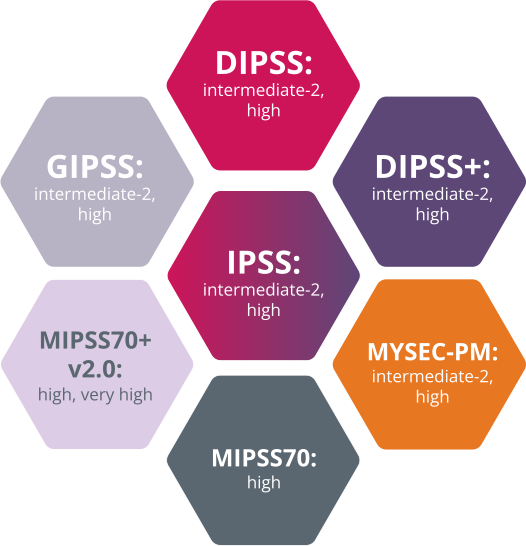
At the time of publication of those recommendations, a median survival of less than 5 years equated to IPSS high and intermediate-2 risk groups (median survival approximately 2.3 and 4.0 years, respectively).1,13
Risk groups from different prognostic scoring systems that predict a median survival of less than 5 years:10,14-18
EBMT/ELN consensus: recommendations for alloSCT in primary MF3
(Risk group according to IPSS, DIPSS or DIPSS+)
Consider the following patients as potential candidates for alloSCT:

High risk or intermediate‑2 risk
AND
age <70 years

Intermediate-1 risk
AND
age <65 years
AND one of the following:
- refractory, transfusion-dependent anaemia
- circulating blasts >2%
- adverse cytogenetics (according to DIPSS+ classification)
- triple negative*
- ASXL1 mutation
The following patients should not be considered for alloSCT:
Low risk patients

Patients in blast transformation
Individual transplant-specific prognostic factors should also be considered in each candidate.
*No mutations to JAK2, CALR or MPL genes.
CALR: calreticulin; EBMT: European Blood and Marrow Transplantation group; ELN: European LeukemiaNet; JAK: Janus kinase; MPL: myeloproliferative leukaemia virus oncogene
Ruxolitinib is a selective inhibitor of JAK1 and JAK2, kinases that mediate signalling involved in haematopoiesis and immune function, and has been shown to reduce spleen size, improve disease-related symptoms and improve overall survival in patients with MF, compared with placebo.19,20 Ruxolitinib is indicated for the treatment of disease-related splenomegaly or symptoms in adult patients with primary or secondary MF.19 Fedratinib is a JAK2-selective inhibitor, licensed in 2021 and also indicated for the treatment of MF-related splenomegaly and symptoms.21

The SMC accepts the use of ruxolitinib and fedratinib in eligible patients of any risk status.22,23
NICE reimbursement for ruxolitinib is available only for patients with intermediate-2 or high risk disease (no prognostic scoring system specified).24 NICE reimbursement for fedratinib is available for patients of any risk status who have previously used ruxolitinib and momelotinib is unsuitable.25
Thus, appropriate determination of a patient’s risk status may be necessary to inform treatment choice.
Treatment approach based on risk2,6,9,26
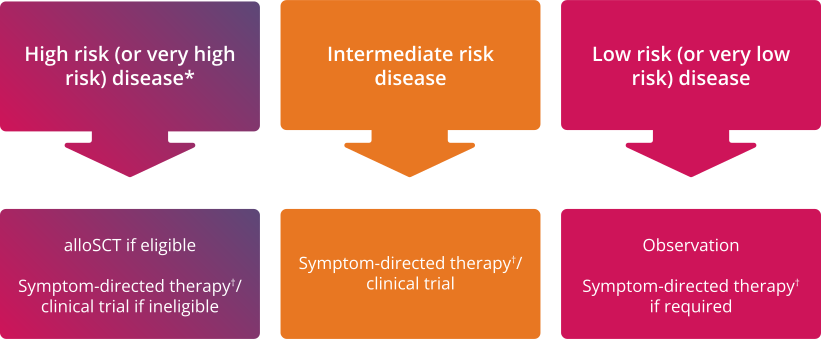
*Depending on scoring system used, patients in an ‘intermediate’ risk group
may be suitable for alloSCT.1
†Symptom-directed drug therapy, anaemia management, radiotherapy for bone
pain, splenectomy.26
alloSCT: allogeneic stem cell transplantation; DIPSS: Dynamic International Prognostic Scoring System; GIPSS: Genetically Inspired Prognostic Scoring System; Hb: haemoglobin; IPSS: International Prognostic Scoring System; MIPSS70: Mutation-enhanced International Prognostic Scoring System for patients under 70 years; MYSEC-PM: Myelofibrosis Secondary to polycythaemia vera and essential thrombocythaemia-Prognostic Model; NICE: National Institute for Health and Care Excellence; SMC: Scottish Medicines Consortium
Adverse events should be reported. Reporting forms and information can be found at
www.mhra.gov.uk/yellowcard.
Adverse events should also be reported to Novartis online through the pharmacovigilance intake (PVI) tool at
www.novartis.com/report
or alternatively email medinfo.uk@novartis.com or call 01276 698370
References
- Barbui T, Barosi G et al. Philadelphia-negative classical myeloproliferative neoplasms: critical concepts and management recommendations from European LeukemiaNet. J Clin Oncol 2011;29(6):761-770
- How J, Hobbs G S. A practical guide for using myelofibrosis prognostic models in the clinic. J Natl Compr Canc Netw 2020;18(9):1271-1278
- Kroger N M, Deeg J H et al. Indication and management of allogeneic stem cell transplantation in primary myelofibrosis: a consensus process by an EBMT/ELN international working group. Leukemia 2015;29(11):2126-2133
- National Comprehensive Cancer Network. NCCN clinical practice guidelines in oncology. Myeloproliferative neoplasms. Available at: nccn.org. Accessed August 2025
- Cruz N M, Gergis U, Silver R T. Myelofibrosis: best practices, controversies and 2019 update. Expert Rev Hematol 2020;13(1):71-84
- Tefferi A, Guglielmelli P et al. Myelofibrosis Treatment Algorithm 2018. Blood Cancer J 2018;8(8):72
- Kim S Y, Bae S H et al. The 2020 revision of the guidelines for the management of myeloproliferative neoplasms. Korean J Intern Med 2021;36(1):45-62
- Reilly J T, McMullin M F et al. Guideline for the diagnosis and management of myelofibrosis. Br J Haematol 2012;158(4):453-471
- Vannucchi A M, Barbui T et al. Philadelphia chromosome-negative chronic myeloproliferative neoplasms: ESMO Clinical Practice Guidelines for diagnosis, treatment and follow-up. Ann Oncol 2015;26 Suppl 5:v85-99
- Guglielmelli P, Lasho T L et al. MIPSS70: Mutation-enhanced International Prognostic Score System for transplantation-age patients with primary myelofibrosis. J Clin Oncol 2018;36(4):310-318
- Danylesko I, Shimoni A. Second malignancies after hematopoietic stem cell transplantation. Curr Treat Options Oncol 2018;19(2):9
- Hamilton B K. Current approaches to prevent and treat GVHD after allogeneic stem cell transplantation. Hematology Am Soc Hematol Educ Program 2018;2018(1):228-235
- Cervantes F, Dupriez B et al. New prognostic scoring system for primary myelofibrosis based on a study of the International Working Group for Myelofibrosis Research and Treatment. Blood 2009;113(13):2895-2901
- Gangat N, Caramazza D et al. DIPSS plus: a refined Dynamic International Prognostic Scoring System for primary myelofibrosis that incorporates prognostic information from karyotype, platelet count, and transfusion status. J Clin Oncol 2011;29(4):392-397
- Passamonti F, Cervantes F et al. A dynamic prognostic model to predict survival in primary myelofibrosis: a study by the IWG-MRT (International Working Group for Myeloproliferative Neoplasms Research and Treatment). Blood 2010;115(9):1703-1708
- Passamonti F, Giorgino T et al. A clinical-molecular prognostic model to predict survival in patients with post polycythemia vera and post essential thrombocythemia myelofibrosis. Leukemia 2017;31(12):2726-2731
- Tefferi A, Guglielmelli P et al. MIPSS70+ Version 2.0: Mutation and karyotype-enhanced International Prognostic Scoring System for primary myelofibrosis. J Clin Oncol 2018;36(17):1769-1770
- Tefferi A, Guglielmelli P et al. GIPSS: Genetically Inspired Prognostic Scoring System for primary myelofibrosis. Leukemia 2018;32(7):1631-1642
- Ruxolitinib Summary of Product Characteristics. Available at: medicines.org.uk
- Verstovsek S, Mesa R A et al. A double-blind, placebo-controlled trial of ruxolitinib for myelofibrosis. N Engl J Med 2012;366(9):799-807
- Fedratinib Summary of Product Characteristics. Available at: medicines.org.uk. Accessed March 2025
- Scottish Medicines Consortium (SMC). SMC No 867/13. Ruxolitinib (as phosphate), 5 mg, 10 mg, & 20 mg tablets (JAKAVI®). 2015. Available at: scottishmedicines.org.uk. Accessed August 2025
- Scottish Medicines Consortium (SMC). SMC No 2462. Fedratinib (Inrebic), April 2022. Available at: scottishmedicines.org.uk. Accessed August 2025
- National Institute for Health and Care Excellence (NICE). Technology appraisal guidance 386. Ruxolitinib for treating disease-related splenomegaly or symptoms in adults with myelofibrosis, March 2016 (last reviewed July 2019). Available at: nice.org.uk. Accessed August 2025
- National Institute for Health and Care Excellence (NICE). Technology appraisal guidance TA1018. Fedratinib for treating disease-related splenomegaly or symptoms in myelofibrosis, November 2024. Available at: nice.org.uk. Accessed August 2025
- Tefferi A. Primary myelofibrosis: 2019 update on diagnosis, risk-stratification and management. Am J Hematol 2018;93(12):1551-1560
© NICE 2016 Ruxolitinib for treating disease-related splenomegaly or symptoms in adults with myelofibrosis. Available from www.nice.org.uk/guidance/ta386. All rights reserved. Subject to Notice of rights.
© NICE 2021 Fedratinib for treating disease-related splenomegaly or symptoms in myelofibrosis. Available from www.nice.org.uk/guidance/ta1018. All rights reserved. Subject to Notice of rights.
NICE guidance is prepared for the National Health Service in England. All NICE guidance is subject to regular review and may be updated or withdrawn. NICE accepts no responsibility for the use of its content in this product/ publication.