Promotional content developed and funded by Novartis Pharmaceuticals UK Ltd
for UK
healthcare professionals only
INGRAIN-MF
Incorporating genetics, risk and
associated burden into MF management
MODULE 3: A personalised approach to predicting prognosis in myelofibrosis

Understanding demographic and clinical risk factors for shortened survival in MF
There is a wide range of survival times observed for patients diagnosed with myelofibrosis (MF).1,2 A variety of different demographic, clinical and genetic risk factors are known to be associated with survival in MF, and can be used to stratify risk and predict survival.1-4 Various treatment options may be available, depending on a patient's risk; for example, allogeneic stem cell transplant should be considered only for patients with a poorer prognosis.2,5
Being able to distinguish between patients who have a good or a poor prognosis can be invaluable for discerning the best management option for each individual.1,2,6
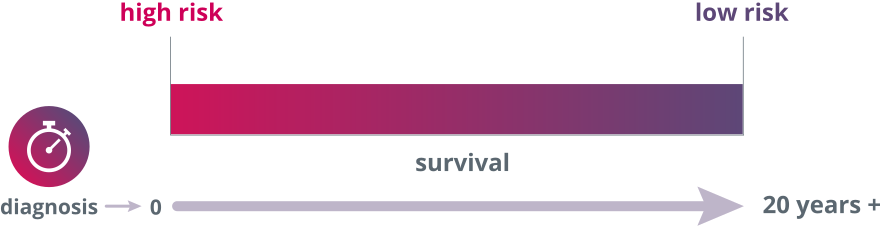
Heterogeneous survival in MF: some patients die shortly after diagnosis, while some survive 20 years or more1,2
Commonly used and well-established prognostic scoring systems for primary MF include:6
- International Prognostic Scoring System (IPSS)1
- Dynamic International Prognostic Scoring System (DIPSS)7
- DIPSS+3
More recent prognostic scoring systems include:6
- Mutation-enhanced International Prognostic Scoring System for transplantation-age patients (MIPSS70)2
- MIPSS70+ v2.04
- Genetically Inspired Prognostic Scoring System (GIPSS)8
Real-world use9
A survey of 42 consultant haematologists in the UK, published in 2020, found that for primary MF:
- all of the consultants used a prognostic scoring system
- 95% used DIPSS and/or DIPSS+
- around half used IPSS
- less than 20% used MIPSS70
In 2009, a study was published which investigated risk factors, present at the time of diagnosis, in 1,054 patients with primary MF (median age 64 years), and how these related to overall survival. 49% of the patients had died by the time of the analysis.
Variables excluded as prognostic factors were: diagnostic period, low white blood cell count (<4 x 10⁹/L) and sex.
Five variables were found to be associated with shorter survival:*
- age >65 years
- constitutional symptoms
- haemoglobin (Hb) <10 g/dL
- white blood cell count >25 x 109/L
- circulating blastocytes >1%
*Using a stepwise Cox regression model, in 1,001 patients for whom data on all five variables was available.
A prognostic scoring system, IPSS, was established, whereby each of these variables scored one point. Total scores define low, intermediate-1, intermediate-2 and high risk categories, which gave discrete, non-overlapping survival curves.
| Risk group | IPSS score | Median survival (years) |
| Low | 0 | |
| Intermediate-1 | 1 | |
| Intermediate-2 | 2 | |
| High | ≥3 |
Unlike IPSS, which is based on risk at the time of diagnosis, DIPSS was designed as a dynamic model to account for the subsequent acquisition of additional risk factors that could affect outcomes. This means that this scoring system can be used at any time during the clinical course of the disease.
During follow-up (median 3.3 years, range 0.6-24 years), the rate of occurrence of risk variables, time to acquisition and association with variables present at diagnosis were analysed in 525 patients with primary MF.
The results gave a similar scoring system to IPSS, but in which Hb <10 g/dL is assigned two points and the other variables one point each.
| Risk group | DIPSS score | Median survival (years) |
| Low | 0 | |
| Intermediate-1 | 1 or 2 | |
| Intermediate-2 | 3 or 4 | |
| High | 5 or 6 |
A further variation on DIPSS included other prognostic factors which had been identified to influence survival:
- the need for red blood cell transfusion
- unfavourable karyotype (complex karyotype, or one or two abnormalities including +8, −7/7q-, i(17q), −5/5q-, 12p-, inv(3) or 11q23 rearrangement)
- thrombocytopenia (platelets <100 x 109/L)
The DIPSS+ model incorporates one point for each of these, in addition to one point for each of the IPSS variables.
| Risk group | DIPSS+ score | Median survival (years) |
| Low | 0 | |
| Intermediate-1 | 1 | |
| Intermediate-2 | 2 or 3 | |
| High | ≥4 |
Adverse events should be reported. Reporting forms and information can be found at
www.mhra.gov.uk/yellowcard.
Adverse events should also be reported to Novartis online through the pharmacovigilance intake (PVI) tool at
www.novartis.com/report
or alternatively email medinfo.uk@novartis.com or call 01276 698370
References
- Cervantes F, Dupriez B et al. New prognostic scoring system for primary myelofibrosis based on a study of the International Working Group for Myelofibrosis Research and Treatment. Blood 2009;113(13):2895-2901
- Guglielmelli P, Lasho T L et al. MIPSS70: Mutation-enhanced International Prognostic Score System for transplantation-age patients with primary myelofibrosis. J Clin Oncol 2018;36(4):310-318
- Gangat N, Caramazza D et al. DIPSS plus: a refined Dynamic International Prognostic Scoring System for primary myelofibrosis that incorporates prognostic information from karyotype, platelet count, and transfusion status. J Clin Oncol 2011;29(4):392-397
- Tefferi A, Guglielmelli P et al. MIPSS70+ Version 2.0: Mutation and karyotype-enhanced International Prognostic Scoring System for primary myelofibrosis. J Clin Oncol 2018;36(17):1769-1770
- Kroger N M, Deeg J H et al. Indication and management of allogeneic stem cell transplantation in primary myelofibrosis: a consensus process by an EBMT/ELN international working group. Leukemia 2015;29(11):2126-2133
- How J, Hobbs G S. A practical guide for using myelofibrosis prognostic models in the clinic. J Natl Compr Canc Netw 2020;18(9):1271-1278
- Passamonti F, Cervantes F et al. A dynamic prognostic model to predict survival in primary myelofibrosis: a study by the IWG-MRT (International Working Group for Myeloproliferative Neoplasms Research and Treatment). Blood 2010;115(9):1703-1708
- Tefferi A, Guglielmelli P et al. GIPSS: Genetically Inspired Prognostic Scoring System for primary myelofibrosis. Leukemia 2018;32(7):1631-1642
- Harrison C N, Mead A J et al. A physician survey on the application of the British Society for Haematology guidelines for the diagnosis and management of myelofibrosis in the UK. Br J Haematol 2020;188(6):e105-e109