Promotional content developed and funded by
Novartis Pharmaceuticals UK Ltd
for UK
healthcare professionals only
INGRAIN-MF
Incorporating genetics,
risk and associated burden
into MF management
MODULE 2: The influence of genetic factors in myelofibrosis

Non-driver mutations in myelofibrosis
The three driver mutations are not sufficient to describe the full molecular and phenotypic heterogeneity of myelofibrosis (MF) - typically, three or more somatic mutations are also found.1,2 These acquired mutations have been identified using next-generation sequencing (NGS) and other whole-genome analysis techniques. However, unlike the driver mutations, they are not restricted to MPNs, and in fact are more frequently found in myelodysplastic syndromes (MDSs) and acute myeloid leukaemia (AML).2
Most of the non-driver MF mutations are involved in phenotypic changes and disease progression.2
Non-driver somatic mutations in MF2,3
| Mutated gene | Function | Incidence in primary MF | Incidence in MPN: ET+PV+MF | |
| Signalling | LNK | Negative regulator of JAK2 | 2% | |
| CBL | Cytokine receptor internalisation | 4% | ||
| Histone modifications | EZH2 | H3K27 methyltransferase | 5%-10% | |
| ASXL1 | Chromatin binding protein associated with PRC1 and 2 | 25%-36% | ||
| RNA splicing | U2AF1 | U2 small nuclear RNA-slicing factor | 10%-16% | |
| SRSF2 | Serine/ arginine-rich pre-RNA splicing factor | 10%-18% | ||
| DNA methylation | TET2 | Alpha-ketoglutarate-dependent dioxygenase | 18% | 10%-20% |
| DNMT3A | DNA methylase | 9% | 5%-10% | |
| IDH1 | Neomorphic enzyme | 1%-3% | ||
| IDH2 | Neomorphic enzyme | 1%-3% |
Adapted from Vainchenker W and Kralovics R, 20172 and Tefferi A et al, 20163
ET: essential thrombocythaemia; MPN: myeloproliferative neoplasm; PV: polycythaemia vera
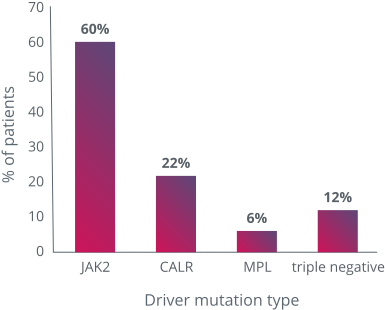
Occurrence of non-driver mutations in 182 patients with primary MF3
NGS with a myeloid neoplasm-relevant 27-gene panel was performed on bone marrow or whole blood DNA from 182 patients diagnosed with primary MF. 81% of patients were found to have mutations in genes other than JAK2, MPL and CALR.
Driver mutation distribution
Number of non-driver mutations
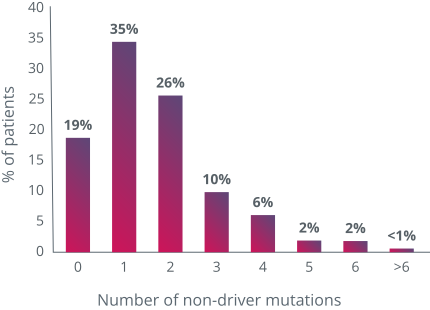
The most frequent non-driver mutation was ASXL1 (36%), followed by TET2 (18%), SRSF2 (18%) and U2AF1 (16%).
Adverse events should be reported. Reporting forms and information
can be found at
www.mhra.gov.uk/yellowcard.
Adverse events should also be reported to Novartis online through
the pharmacovigilance intake (PVI) tool at
www.novartis.com/report
or alternatively email
medinfo.uk@novartis.com
or call 01276 698370
References
- Rumi E, Pietra D et al. Clinical effect of driver mutations of JAK2, CALR, or MPL in primary myelofibrosis. Blood 2014;124(7):1062-1069
- Vainchenker W, Kralovics R. Genetic basis and molecular pathophysiology of classical myeloproliferative neoplasms. Blood 2017;129(6):667-679
- Tefferi A, Lasho T L et al. Targeted deep sequencing in primary myelofibrosis. Blood Adv 2016;1(2):105-111