Promotional content developed and funded by Novartis Pharmaceuticals UK Ltd
for UK
healthcare professionals only
INGRAIN-MF
Incorporating genetics, risk and
associated burden into MF management
MODULE 2: The influence of genetic factors in myelofibrosis

Implications of genetic profile: diagnosis, prognosis and treatment response
Driver mutations in myelofibrosis (MF), ie JAK2 V167F, MPL and CALR mutations, are intrinsically linked with the development and progression of the disease, and as such, are informative with regards to diagnosis, prognosis and treatment response.1,2
Driver mutations - diagnosis
One of the WHO major diagnostic criteria for overt primary MF, which must be met for the diagnosis to be made, is the absence of reactive (secondary) MF or the presence of one of the following mutations:3
- JAK2
- CALR
- MPL
- other clonal marker, eg ASXL1, EZH2, TET2, IDH1/IDH2, SRSF2, SF3B1
The presence or absence of driver mutations can significantly affect disease outcomes for patients with MF, influencing risk of abnormal blood counts, transformation to acute myeloid leukaemia (AML) and overall survival.4
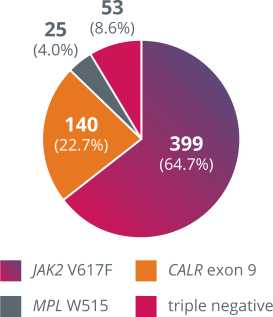
Effect of driver mutations in a study of 617 patients4
Mutation distribution
(number of patients)
Median survival
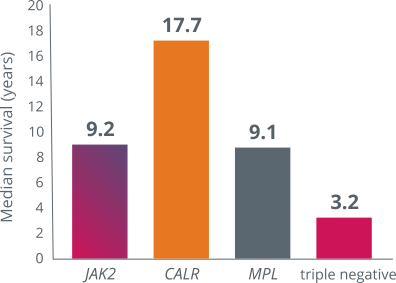
In a multivariate analysis corrected for age, patients with a CALR mutation had better overall survival compared with those with a JAK2 mutation (p=0.019) or triple negative patients (p<0.001)
Clinical course
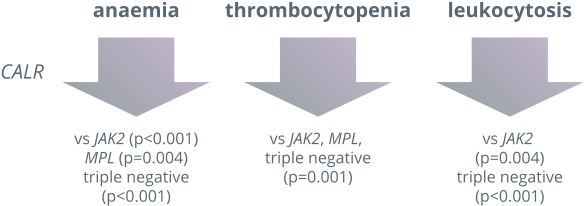
Triple negative patients showed a high risk of marked leukocytosis, especially at 3 years (>30%)
Leukaemic transformation
10-year cumulative incidence
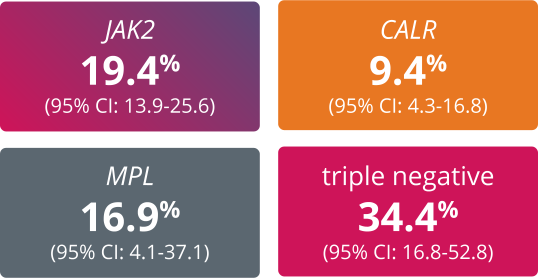

CALR mutation was associated with a lower risk of thrombosis compared with JAK2 mutation (p=0.021)
Note: the favourable prognosis of CALR mutation appears to be limited to type 1/ type-1-like mutations, with type 2 mutation being associated with a prognosis similar to that of patients with a JAK2 mutation.4,5
Non-driver mutations help to explain the heterogeneity of disease phenotype (eg presence of anaemia) and progression (including transformation to leukaemia) observed with MF, thus knowledge of an individual’s mutational profile can have important prognostic value.2,6
A study of 879 patients* with primary MF investigated the effect on survival and leukaemic transformation of mutations in ASXL1, SRSF2, EZH2, TET2, DNMT3A, CBL, IDH1, IDH2, MPL and JAK2.7
| Lower overall survival (mutation vs wild-type) was observed for:7 | Higher risk of leukaemia (mutation vs wild-type) was observed for:7 |
| EZH2 (p=0.025)† | EZH2 (non-significant)† |
| ASXL1 (p<0.0001)† | ASXL1 (p<0.0001)† |
| SRSF2 (p<0.0001)† | SRSF2 (p=0.005)† |
| IDH1/2 (p=0.03)† |
Patients with at least one of these mutations were defined as 'mutationally high-risk', compared with those with none ('mutationally low-risk').7 This is the same categorisation as in the MIPSS risk stratification system.6

High-risk: at least one mutation in ASXL2, EZH2, SRSF2 or IDH1/2

Low risk: no mutations in ASXL2, EZH2, SRSF2 or IDH1/2
*Analysis in 483 patients and validation of observations in a further 396 patients.7
†p-values according to multivariate analysis.
MIPSS: Mutation-enhanced International Prognostic Score System
The mutations harboured by an individual appear to affect treatment outcomes and may be useful for understanding variation in response.1,8
A phase I/II study of 95 patients with primary or secondary MF being treated with the JAK inhibitor, ruxolitinib, used next-generation sequencing (NGS) of DNA extracted from bone marrow or peripheral blood to investigate any correlation between mutation profile and treatment response.8
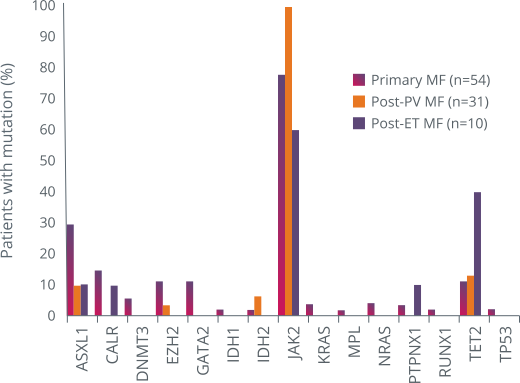
Adapted from Patel K P et al, 20158
ET: essential thrombocythaemia; PV: polycythaemia vera
Mutation profile effect on treatment outcome
Patients achieving a spleen response (≥50% reduction in palpable spleen size) with ruxolitinib treatment:
| Total number of mutations | ≥3 25% (3/12) |
2 79% (23/30) |
p=0.001 |
| Number of ASXL1, EZH2 or IDH1/2 mutations | ≥1 52% (14/27) |
0 80% (49/68) |
p=0.01 |
Patients with fewer than three mutations had nine-fold higher odds of a spleen response than those with three or more mutations (OR: 9.37; 95% CI: 1.86-47.2)
CI: confidence interval; OR: odds ratio
Time to discontinuation of treatment with ruxolitinib:
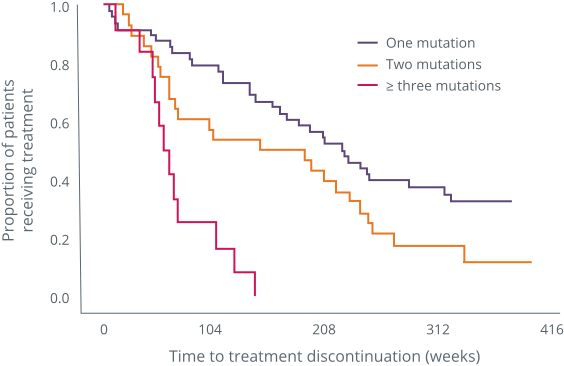
Adapted from Patel K P et al, 20158
Treatment discontinuation was also correlated to the presence of an ASXL1, DNMT2A or EZH2 mutation. Patients with one or more mutations in these genes had a four-fold higher hazard of treatment discontinuation than those with none (p<0.001).
There are some indications that JAK2 mutant allele burden is correlated with treatment success for ruxolitinib:1
- a progressive decrease in allele burden with ruxolitinib treatment has been observed
- a small study indicated that patients with an allele burden of >50% at treatment initiation had a higher probability of spleen response than those with a lower burden
Allogeneic stem cell transplantation:
A retrospective study of 18 patients with MF who had undergone transplantation and who had an MPL mutation found a favourable outcome and low rate of disease relapse (<6%) associated with this mutation compared with available historical controls.9
The typical prognostic scoring systems used for MF are IPSS, DIPSS and DIPSS+, and include factors such as age, haemoglobin, white blood cell count, circulating blasts and constitutional symptoms.10-12 However, more recently developed algorithms additionally consider genetic and cytogenetic factors.6,13,14
The Mutation-enhanced International Prognostic Score System for patients with primary MF aged ≤70 (MIPSS70) includes scores for:6
- absence of CALR type 1 mutations
- presence of high-molecular risk (HMR) mutations, eg ASXL1, EZH2, SRSF2, IDH1/2
- presence of ≥2 HMR mutations
MIPPS70+ additionally includes U2AF1 Q157 mutation as a HMR mutation, and includes a cytogenetic risk variable, allocating four points for a very high risk (VHR) karyotype or three points for an unfavourable karyotype.13
Cytogenetic riskThe Genetically-Inspired Prognostic Scoring System (GIPSS) for primary MF is based solely on genetic markers:14
- VHR or unfavourable karyotype
- absence of type-1 (-like) CALR mutation
- presence of ASXL1, SRSF2 or U2AF1 Q157 mutation
DIPSS: Dynamic International Prognostic Scoring System; IPSS: International Prognostic Scoring System
Adverse events should be reported. Reporting forms and information can be found at
www.mhra.gov.uk/yellowcard.
Adverse events should also be reported to Novartis online through the pharmacovigilance intake (PVI) tool at
www.novartis.com/report
or alternatively email medinfo.uk@novartis.com or call 01276 698370
References
- Loscocco G G, Guglielmelli P, Vannucchi A M. Impact of mutational profile on the management of myeloproliferative neoplasms: a short review of the emerging data. Onco Targets Ther 2020;13:12367-12382
- Vainchenker W, Kralovics R. Genetic basis and molecular pathophysiology of classical myeloproliferative neoplasms. Blood 2017;129(6):667-679
- Arber D A, Orazi A et al. The 2016 revision to the World Health Organization classification of myeloid neoplasms and acute leukemia. Blood 2016;127(20):2391-2405
- Rumi E, Pietra D et al. Clinical effect of driver mutations of JAK2, CALR, or MPL in primary myelofibrosis. Blood 2014;124(7):1062-1069
- Palumbo G A, Stella S et al. The role of new technologies in myeloproliferative neoplasms. Front Oncol 2019;9:321
- Guglielmelli P, Lasho T L et al. MIPSS70: Mutation-enhanced International Prognostic Score System for transplantation-age patients with primary myelofibrosis. J Clin Oncol 2018;36(4):310-318
- Vannucchi A M, Lasho T L et al. Mutations and prognosis in primary myelofibrosis. Leukemia 2013;27(9):1861-1869
- Patel K P, Newberry K J et al. Correlation of mutation profile and response in patients with myelofibrosis treated with ruxolitinib. Blood 2015;126(6):790-797
- Mannina D, Gagelmann N et al. Allogeneic stem cell transplantation in patients with myelofibrosis harboring the MPL mutation. Eur J Haematol 2019;103(6):552-557
- Cervantes F, Dupriez B et al. New prognostic scoring system for primary myelofibrosis based on a study of the International Working Group for Myelofibrosis Research and Treatment. Blood 2009;113(13):2895-2901
- Gangat N, Caramazza D et al. DIPSS plus: a refined Dynamic International Prognostic Scoring System for primary myelofibrosis that incorporates prognostic information from karyotype, platelet count, and transfusion status. J Clin Oncol 2011;29(4):392-397
- Passamonti F, Cervantes F et al. A dynamic prognostic model to predict survival in primary myelofibrosis: a study by the IWG-MRT (International Working Group for Myeloproliferative Neoplasms Research and Treatment). Blood 2010;115(9):1703-1708
- Tefferi A, Guglielmelli P et al. MIPSS70+ Version 2.0: Mutation and karyotype-enhanced International Prognostic Scoring System for primary myelofibrosis. J Clin Oncol 2018;36(17):1769-1770
- Tefferi A, Guglielmelli P et al. GIPSS: Genetically Inspired Prognostic Scoring System for primary myelofibrosis. Leukemia 2018;32(7):1631-1642
- Tefferi A, Nicolosi M et al. Revised cytogenetic risk stratification in primary myelofibrosis: analysis based on 1002 informative patients. Leukemia 2018;32(5):1189-1199