Promotional content developed and funded by Novartis Pharmaceuticals UK Ltd
for UK
healthcare professionals only
INGRAIN-MF
Incorporating genetics, risk and
associated burden into MF management
MODULE 2: The influence of genetic factors in myelofibrosis

Driver mutations in myelofibrosis
Myelofibrosis (MF) is a myeloproliferative neoplasm characterised by bone marrow fibrosis and abnormal haematopoiesis, including proliferation of megakaryocytes, extramedullary haematopoiesis and progressive anaemia.1,2
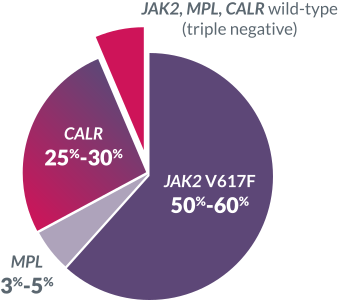
There are three major 'driver' mutations associated with MF, namely mutations to the JAK2, CALR and MPL genes. Mutation of any one of these genes accounts for approximately 90% of myelofibrosis cases. They are usually mutually exclusive, however co-occurrence has been reported. Patients in which these driver mutations are not observed are referred to as 'triple negative'.3
CALR: calreticulin; JAK: Janus kinase; MPL: myeloproliferative leukaemia virus oncogene
JAK2 V617F
JAK2 is a tyrosine kinase which becomes activated when ligands bind specific cytokine receptors with which it is associated. This leads to the regulation of genes involved in cell proliferation and survival.4
Mutation of valine 617 in JAK2 to a phenylalanine is detected in 50%-60% of patients with primary MF.3 This mutation arises in multipotent haematopoietic progenitor cells and is present in all myeloid lineages; it can also be detected in lymphoid cells.5
JAK2 V167F can cause ligand-independent activation of the receptors for erythropoietin (EPO), thrombopoietin (TPO) and granulocyte-colony stimulating factor (G-CSF), thus causing an increase in the production of red blood cells, megakaryocytes and platelets, and granulocytes, respectively.3
CALR
CALR is a calcium binding protein with chaperone activity, involved in diverse functions including protein quality control, calcium metabolism, immune response and cell adhesion. CALR variants found in MPNs, with the C-terminus of the protein enriched for positively charged amino acids, can bind to the MPL/ TPO receptor, thus activating the JAK-STAT pathway.4 They can also activate the G-CSF receptor at a low level.5
CALR mutations are the second most common genetic abnormality in MPNs, mostly either type 1 (52 base pair deletion in exon 9) or type 2 (5 base pair insertion in exon 9). For patients with primary MF and a CALR mutation, 83% have type 1 or type 1-like abnormalities, and 15% type 2 or type 2-like.4
MPL
The MPL gene encodes the TPO receptor. Mutations have been identified which result in constitutive activation of this receptor, independent of cytokine binding.4
Activating MPL mutations have been reported in 5%-10% of patients with primary MF. All occur in exon 10 and the majority involve a single amino acid substitution at tryptophan 515.4
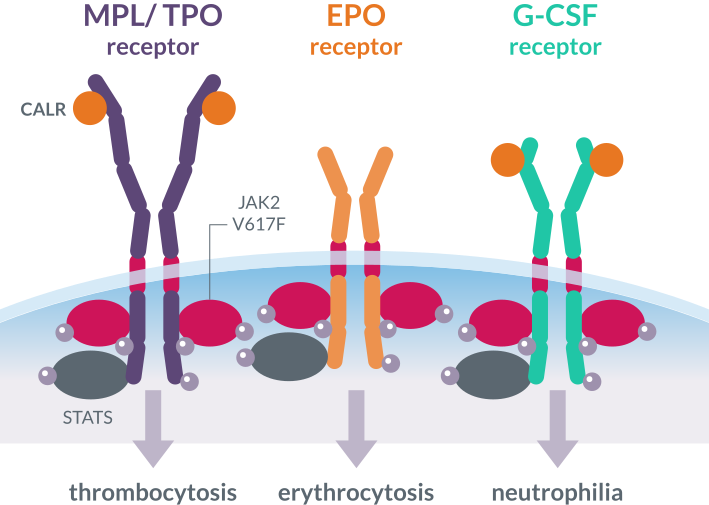
JAK2 V167F can activate all three receptors. CALR variants mostly activate the MPL/ TPO receptor, but may also activate G-CSF at a low level. MPL variants can cause constitutive activation of the MPL/ TPO receptor.5
Adapted from Vainchenker W and Kralovics R, 20175
JAK-STAT: Janus kinase-signal transducer and activator of transcription
Continue to next section: Non-driver mutations in MF
Adverse events should be reported. Reporting forms and information can be found at
www.mhra.gov.uk/yellowcard.
Adverse events should also be reported to Novartis online through the pharmacovigilance intake (PVI) tool at
www.novartis.com/report
or alternatively email medinfo.uk@novartis.com or call 01276 698370
References
- Harrison C N, Mead A J et al. A physician survey on the application of the British Society for Haematology guidelines for the diagnosis and management of myelofibrosis in the UK. Br J Haematol 2020;188(6):e105-e109
- Rumi E, Pietra D et al. Clinical effect of driver mutations of JAK2, CALR, or MPL in primary myelofibrosis. Blood 2014;124(7):1062-1069
- Loscocco G G, Guglielmelli P, Vannucchi A M. Impact of mutational profile on the management of myeloproliferative neoplasms: a short review of the emerging data. Onco Targets Ther 2020;13:12367-12382
- Palumbo G A, Stella S et al. The role of new technologies in myeloproliferative neoplasms. Front Oncol 2019;9:321
- Vainchenker W, Kralovics R. Genetic basis and molecular pathophysiology of classical myeloproliferative neoplasms. Blood 2017;129(6):667-679