Promotional content developed and funded by Novartis Pharmaceuticals UK Ltd
for UK
healthcare professionals only
INGRAIN-MF
Incorporating genetics, risk and
associated burden into MF management
MODULE 4: Optimising management of myelofibrosis and evaluating the use of JAK inhibitors

Practical usage of ruxolitinib in MF management
Tolerability and safety profile
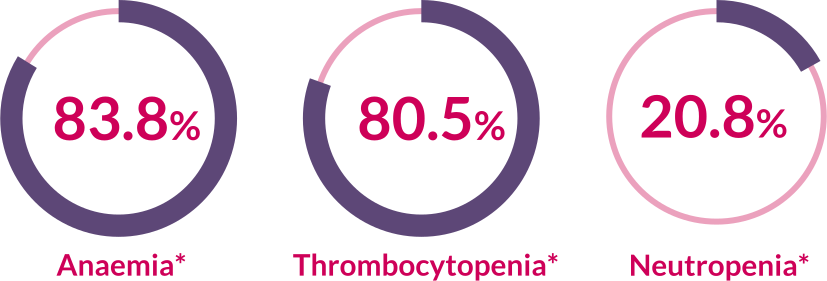
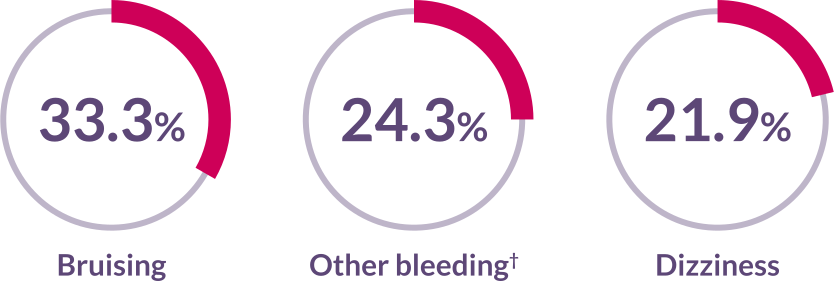
In patients with myelofibrosis (MF) who received ruxolitinib in COMFORT-I and COMFORT-II, the most commonly reported adverse events (AEs) were:1
Non-haematological AEs
*Any Common Terminology Criteria for Adverse Events (CTCAE) grade.1
†Including epistaxis, post-procedural haemorrhage and haematuria.1
Please refer to the SmPC for further information about adverse events.1
Discontinuation due to adverse events, regardless of causality, was observed in 30.0% of patients.1
Occurrence of anaemia and thrombocytopenia can typically be managed in patients being treated with ruxolitinib.2-4 As such, despite being the most frequently reported AEs in the phase III trials, their occurrence rarely led to treatment discontinuation.2,3
| Discontinuation of ruxolitinib due to anaemia: | Discontinuation of ruxolitinib due to thrombocytopenia: | |
| COMFORT-I (N=155) | 1 patient | 1 patient |
| COMFORT-II (N=146) | 0 patients | 1 patient |
Management of thrombocytopenia
Management of patients receiving ruxolitinib in the phase III clinical trials who developed thrombocytopenia:
‡Platelet count <50 x 109/L.
Disease-related anaemia is one of the hallmarks of MF, and is a well-established risk factor for shorter survival.5
35%-54% of patients present with marked anaemia (Hb <10 g/dL) at diagnosis.5
Treatment-related anaemia was common in COMFORT-I and COMFORT-II, but manageable using dose adjustments and red blood cell (RBC) transfusions:3,4

- Occurrence of anaemia peaked 8-12 weeks after therapy was initiated
- Recovered to near‑baseline levels by 24 weeks
In COMFORT-II: 51% of patients required at least one RBC transfusion compared with 38% in the BAT group, with higher transfusion rates seen in patients initiated onto a higher ruxolitinib dose.2
British Society for Haematology guidelines for anaemia management in MF6
Initial management of anaemia should address any deficiencies of iron, folate, vitamin B12 and/or autoimmune haemolysis.
Erythropoiesis-stimulating agents (ESAs)
A trial of ESAs, including in combination with ruxolitinib, is recommended for patients with inadequate serum EPO levels (EPO <500 units/L is often used in clinical practice):
- Recombinant EPO OR darbepoietin
- Dose escalation after 6-8 weeks if required
- Discontinue treatment after 12 weeks if no response
Androgens
A trial of danazol, with or without ruxolitinib, is recommended in patients failing ESA:
- Assess response at 12 weeks
- Continue for initial period of 6 months
- Monitor for androgen-related side effects such as hirsutism
- Monitor liver function
- Monitor PSA in males
Immunomodulating drugs
For those failing ESA and/or danazol, immunomodulatory drugs (thalidomide, lenalidomide, pomalidomide) can be trialled, either alone or in combination with prednisolone.
Other alternatives
Depending on availability, other alternatives may include momelotinib, luspatercept and drug combinations.
Transfusion
RBC transfusions are the mainstay of anaemia management when other measures are ineffective.
EPO: erythropoietin; Hb: haemoglobin
Optimal dose of ruxolitinib depends on an individual's disease characteristics4
Dosing can be titrated according to safety and efficacy1
A complete blood cell count, including a white blood cell count differential, must be performed before initiating therapy with ruxolitinib. Please refer to the SmPC for further information.1
Ruxolitinib treatment should be withdrawn in patients with:1
- platelet count <50 x 109/L
- absolute neutrophil count <0.5 x 10⁹/L
Dosing and optimisation over the first 6 months of treatment with ruxolitinib1
Initiation

Starting dose1
Based on platelet count:
- >200 x 109/L: 20 mg twice daily
- 100 - 200 x 109/L: 15 mg twice daily
- 75 - 100 x 109/L: 10 mg twice daily
- 50 - <100 x 109/L: 5 mg twice daily maximum (monitor and titrate cautiously)
Monitoring1
Complete blood count should be monitored every 2 to 4 weeks until dose is stabilised, then as clinically indicated.
Approx 4 weeks
Dose titration1
Doses should not be increased during the first 4 weeks of therapy.
Doses should not be increased more frequently than at 2-week intervals.
Dose should be titrated based on safety and efficacy. Doses may be increased by a maximum of 5 mg twice daily, up to the maximum dose of 25 mg twice daily.
Approx 8 weeks
Thrombocytopenia1
Management: Usually managed by reducing or temporarily withholding ruxolitinib. Interrupt treatment if platelet count <50 x 109/L or absolute neutrophil count reduced to <500/mm3. Restart at 5 mg twice daily once recovered. Consider dose reduction to avoid dose interruption due to thrombocytopenia.
Approx 8‑12 weeks
24 weeks
Approx 8‑12 weeks
Anaemia1
Management: Patients with anaemia may require blood transfusions.
Dose modifications or interruption for patients developing anaemia may also be considered.
24 weeks
Stabilisation of platelet and haemoglobin levels1
Continue to monitor complete blood count as clinically indicated.
6 months
Efficacy1
Discontinue ruxolitinib after 6 months if there is no spleen size reduction or symptom improvement.
It is recommended that, for patients who have demonstrated some degree of clinical improvement, treatment is discontinued if they sustain an increase in their spleen length of 40% compared with baseline size (roughly equivalent to a 25% increase in spleen volume) and no longer have tangible improvement in disease-related symptoms.
Continuation of treatment1
Treatment may continue as long as the benefit/ risk balance remains positive.
After interruption or discontinuation of ruxolitinib dosing, symptoms of myelofibrosis may return over a period of approximately 1 week.
Unless abrupt discontinuation is required, gradual tapering of the dose may be considered, although the utility of tapering is unproven.
Adverse events should be reported. Reporting forms and information can be found at
www.mhra.gov.uk/yellowcard.
Adverse events should also be reported to Novartis online through the pharmacovigilance intake (PVI) tool at
www.novartis.com/report
or alternatively email medinfo.uk@novartis.com or call 01276 698370
References
- Ruxolitinib Summary of Product Characteristics. Available at: medicines.org.uk
- Harrison C, Kiladjian J-J et al. JAK inhibition with ruxolitinib versus best available therapy for myelofibrosis. N Engl J Med 2012;366(9):787-798
- Verstovsek S, Mesa R A et al. A double-blind, placebo-controlled trial of ruxolitinib for myelofibrosis. N Engl J Med 2012;366(9):799-807
- Mesa R A, Cortes J. Optimizing management of ruxolitinib in patients with myelofibrosis: the need for individualized dosing. J Hematol Oncol 2013;6:79
- Harrison C, Mesa R et al. Practical management of patients with myelofibrosis receiving ruxolitinib. Expert Rev Hematol 2013;6(5):511-523
- McLornan D P, Psaila B et al. The management of myelofibrosis: A British Society for Haematology Guideline. Br J Haematol 2024;204:136-150
- Palandri F, Tiribelli M et al. Ruxolitinib rechallenge in resistant or intolerant patients with myelofibrosis: Frequency, therapeutic effects, and impact on outcome. Cancer 2021;127:2657-2665